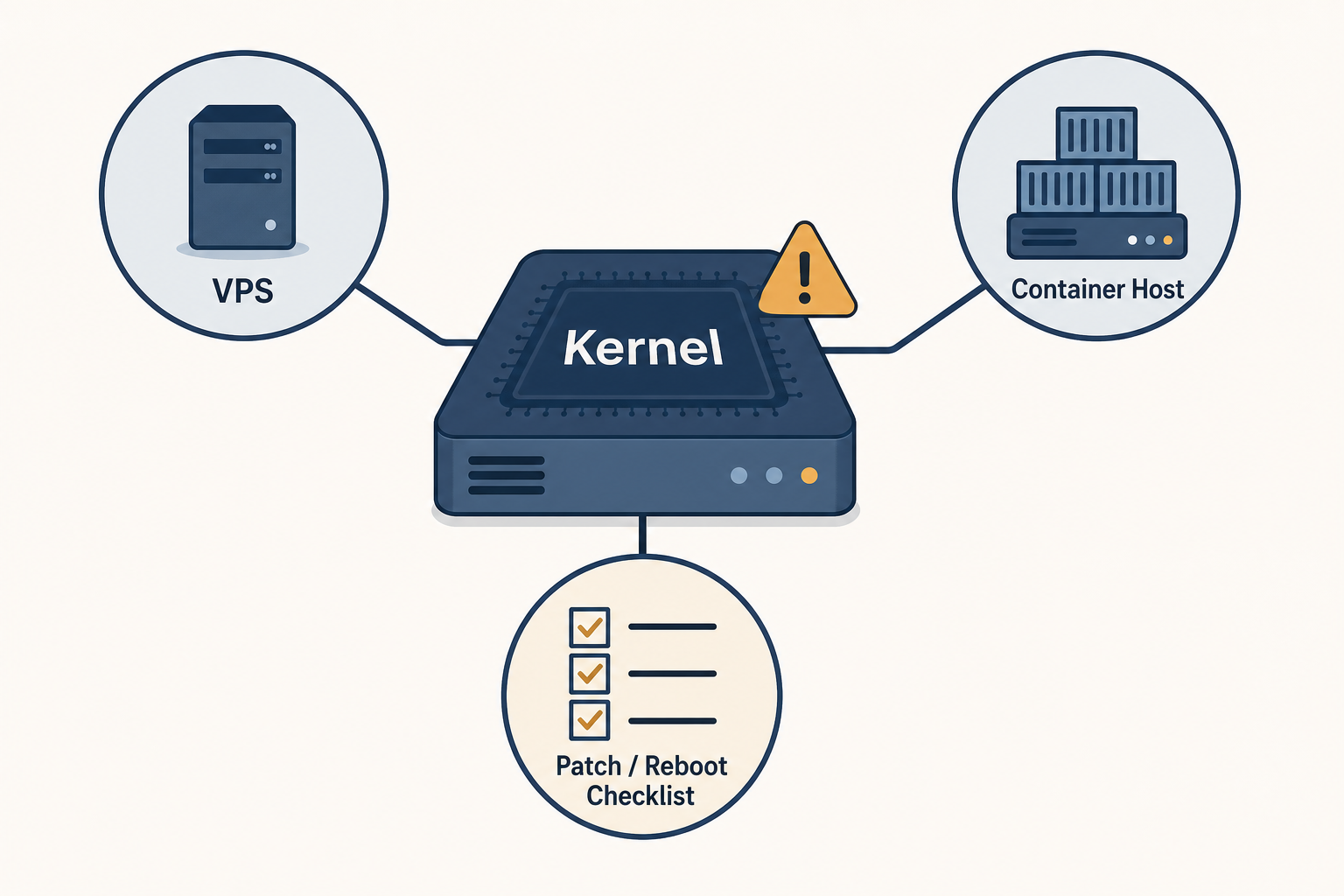
Copy Fail, tracked as CVE-2026-31431, is a local privilege-escalation issue in the Linux kernel’s cryptographic interface. For small server operators, the practical response is patch the kernel, reboot when the fixed kernel requires it, and take local-user and container-host risk seriously.
This is not a “your SSH port is instantly owned from the internet” story. It is a reminder that local bugs become serious when an attacker already has a foothold, a shell, a compromised web app, or a shared-hosting-style account.
What is Copy Fail?
Public writeups describe Copy Fail as a Linux kernel flaw involving the AF_ALG userspace crypto interface and splice() behavior, with potential page-cache corruption leading to local root in vulnerable kernels. Several advisories classify it as high or important because an unprivileged local user may be able to escalate privileges.
That distinction matters. The attacker needs local code execution first. On a single-purpose VPS, that often means the realistic path is through a compromised application, stolen account, unsafe container workload, or another vulnerability that gives a local process.
Why should container hosts care?
Containers share the host kernel. If a kernel local-privilege-escalation bug is reachable from a workload, “it was only inside a container” may not be enough comfort.
Container hardening still helps, but kernel patching is the control that removes the vulnerable host code. This is why Docker rootless mode is a layer, not a replacement for host maintenance.
What should a small-server operator do first?
Start with the boring work:
- Read your distro’s advisory for CVE-2026-31431.
- Apply the vendor kernel update through normal repositories.
- Schedule a reboot if the running kernel is still vulnerable after the update.
- Review local accounts, CI users, web app users, and container workloads.
- Watch for vendor-specific mitigation guidance, but prefer the fixed kernel.
For update planning, use the same discipline as Ubuntu unattended upgrades, Livepatch, and reboot windows.
Should you use a module-disable mitigation?
Only use a temporary mitigation if your vendor recommends it for your kernel and workload. Some kernel features are built in, packaged differently, or needed by legitimate software.
A mitigation copied from another distro forum can fail silently, break workloads, or give false confidence. The durable fix is the vendor kernel update plus the required reboot.
What is the exposure model?
The highest-risk systems are multi-user servers, container hosts running untrusted workloads, CI/build boxes, shell-hosting environments, and internet-facing app servers where a web compromise could become local code execution.
The lower-risk case is a private single-admin box with no untrusted local users and no exposed application surface. Lower risk is not zero risk. Patch it anyway.
FAQ
Is Copy Fail remotely exploitable by itself?
Public summaries describe it as a local privilege-escalation issue, not a direct remote-open-port issue.
Does rebooting matter?
For kernel fixes, usually yes. Installing a fixed kernel does not necessarily change the kernel currently running in memory.
Are containers enough protection?
No. Containers share the host kernel, so host kernel patching remains part of container security.
Sources
- Sysdig CVE-2026-31431 Copy Fail summary: https://www.sysdig.com/blog/cve-2026-31431-copy-fail-linux-kernel-flaw-lets-local-users-gain-root-in-seconds
- Red Hat Copy Fail security bulletin: https://access.redhat.com/security/vulnerabilities/RHSB-2026-002
- Xint technical disclosure: https://xint.io/blog/copy-fail-linux-distributions