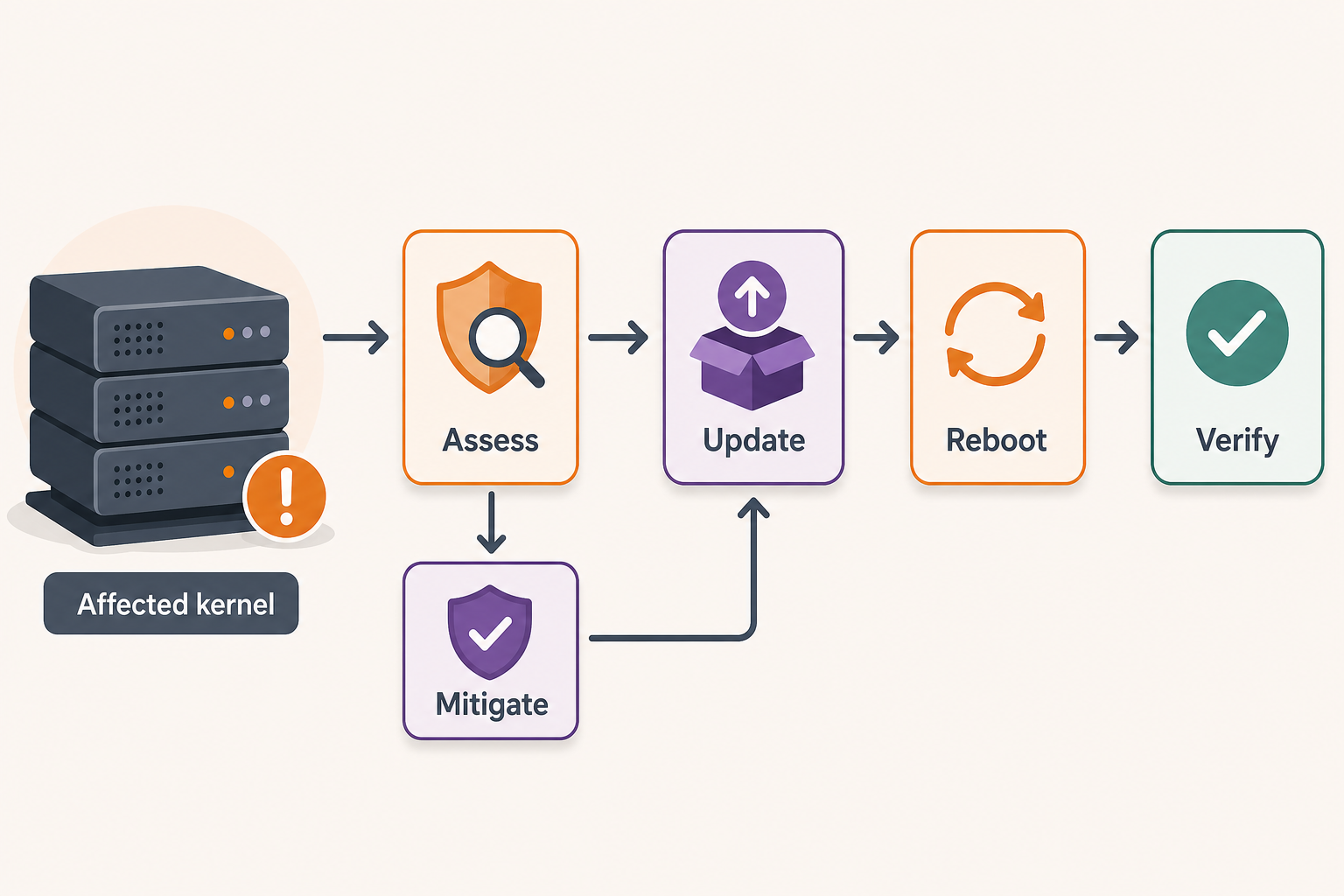
CVE-2026-46333, often called ssh-keysign-pwn, is a Linux kernel information-disclosure vulnerability with public attention because of proof-of-concept exploit naming. For Ubuntu admins, the calm response is to follow Ubuntu’s security notice, patch the kernel, reboot when required, and avoid treating temporary mitigations as permanent policy.
The name mentions SSH, but the practical admin action is kernel maintenance and local-user risk review.
What is CVE-2026-46333?
Ubuntu describes CVE-2026-46333 as an information-disclosure vulnerability in the Linux kernel that can disclose sensitive files to unprivileged local users. Ubuntu assigned it High priority and published mitigation guidance before fixed kernel updates were available.
That makes it serious, but it is still a local exposure story. The operator question is: who can run code as an unprivileged user on this system, directly or through an application?
Why did Ubuntu mention mitigations?
Ubuntu’s blog described mitigations that reduce exploitability before fixed kernels are available, but with an operational cost: unprivileged users may lose access to debugging tools such as gdb and gcore.
That is a tradeoff, not a free switch. On production servers, disabling debugging paths may be acceptable temporarily. On development systems, it can break normal work.
What should Ubuntu server admins do?
Use this order:
- Check Ubuntu Security Notices for the affected release.
- Install the fixed kernel from Ubuntu repositories when available.
- Reboot into the fixed kernel if the update requires it.
- Remove or revisit temporary mitigations after the fixed kernel is active.
- Review local users, SSH access, CI accounts, and container workloads.
This pairs with the existing Ubuntu unattended upgrades and reboot policy and CISA KEV triage model.
Who is most exposed?
Systems with many local users, shared development boxes, build servers, container hosts, and app servers where a web vulnerability could become local code execution deserve faster attention.
A locked-down single-purpose VPS still needs patching, but the immediate risk depends on whether untrusted code can run locally.
Do not overfit on the exploit name
The exploit nickname is useful for search, but it can distort the mental model. This is not primarily an SSH configuration hardening problem. It is a kernel information-disclosure problem that may be reached through local execution.
Keep SSH private where possible, but do not mistake an SSH-only response for kernel remediation.
FAQ
Is this fixed by changing SSH settings?
No. SSH access control can reduce who gets a shell, but the vulnerability is in the kernel and needs a kernel fix or vendor-approved mitigation.
Should I disable debugging tools permanently?
Not by default. Treat debugging restrictions as a temporary mitigation unless your operating policy deliberately requires them.
Does Livepatch remove the need to reboot?
Check Ubuntu’s advisory for the specific kernel and release. Do not assume every kernel issue is fully handled without a reboot.
Sources
- Ubuntu CVE-2026-46333 mitigation post: https://ubuntu.com/blog/ssh-keysign-pwn-linux-vulnerability-fixes-available
- NVD CVE-2026-46333 record: https://nvd.nist.gov/vuln/detail/cve-2026-46333
- AlmaLinux CVE-2026-46333 patch note: https://almalinux.org/blog/2026-05-15-ssh-keysign-pwn-cve-2026-46333