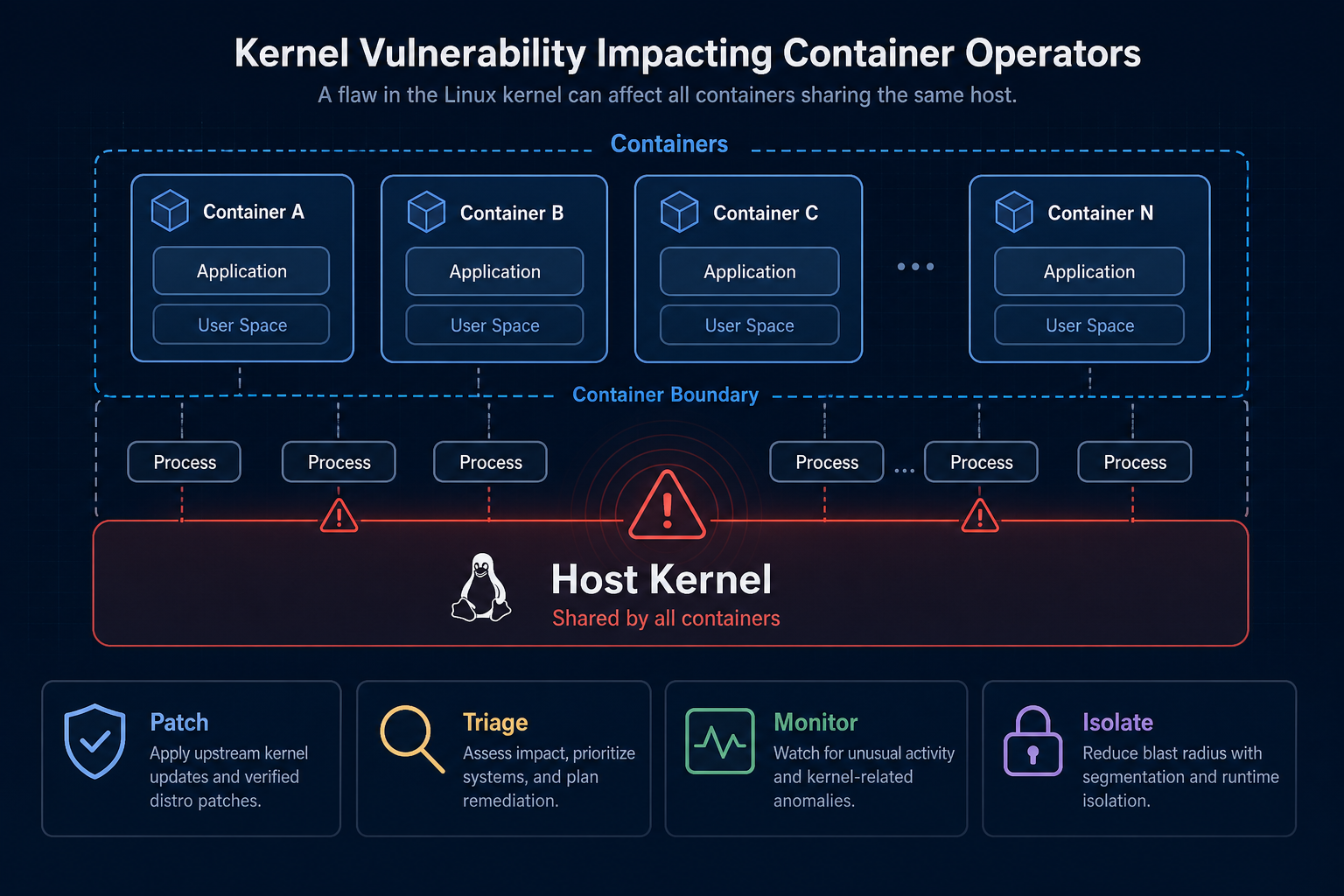
Copy Fail, tracked as CVE-2026-31431, deserves kernel-focused triage. Operators should identify affected kernel lines, check vendor fixes, assess local-user and container exposure, and patch through the distribution’s supported path.
Is this automatically a container escape?
No. A vulnerability headline does not establish that every container workload is exploitable or that a host is affected. The practical question is whether the host kernel and workload match the vendor’s affected scope and whether a fixed package or mitigation is available.
What should operators do?
- Check the primary CVE record and your distribution’s advisory.
- Record the running kernel and installed kernel packages.
- Check whether the vendor has published a fixed package for the host release.
- Review who can run local code and whether containers are rootless or privileged.
- Patch, reboot when required, and verify the running kernel and services.
Do not publish a fixed version or exploitability claim until the vendor notice and package tracker agree. For container context, review Docker rootless and user namespaces as one layer, not a complete answer.
What remains important after patching?
Keep management interfaces private, reduce unnecessary container privilege, and maintain a recovery path. Kernel patching does not fix exposed dashboards, weak credentials, or overbroad Docker access.
Sources
- Ubuntu Livepatch notice: https://ubuntu.com/security/notices/LSN-120-1
- NVD CVE database: https://nvd.nist.gov/
- Linux kernel security: https://www.kernel.org/